 English
  Chinese
 When shopping for a battery charger, many people assume that a higher charging current means faster charging and better performance. After all, bigger numbers often seem more impressive. But when it comes to battery chargers, bigger is not always better – in fact, choosing a charger with too high a current can damage your battery and shorten its lifespan.
So, what’s the right approach? Let’s break it down.
1. Charging current must match battery capacity
Every battery has a recommended charging current, usually expressed as a fraction of its capacity (C). For example, a 50Ah lead-acid battery is typically best charged at 5A–10A (0.1C–0.2C). Using a 30A charger on that small battery would generate excessive heat, cause electrolyte loss, and potentially warp the plates – permanently reducing performance.
2. High current = high heat = high risk
Heat is the enemy of all batteries. When you force a large current into a battery that cannot accept it quickly, internal temperature rises sharply. For lead-acid batteries, this can lead to thermal runaway, boiling electrolyte, and even explosion in extreme cases. For lithium batteries, overcurrent charging may trigger the protection circuit or, worse, cause battery swelling or fire.
3. Different batteries have different needs
- Starting batteries (e.g., in cars): Designed for short, high-current bursts, but they require low, slow charging (typically 2A–10A) for recovery.
- Deep-cycle batteries (e.g., for RVs, golf carts): Need even more careful charging – a high-current “fast charger” can reduce cycle life dramatically.
- Lithium batteries (LiFePO₄, etc.): They can accept higher currents, but still within limits set by the manufacturer (e.g., 0.5C max). Exceeding that risks tripping the BMS (Battery Management System) or damaging cells.
4. Smart chargers vs. brute force
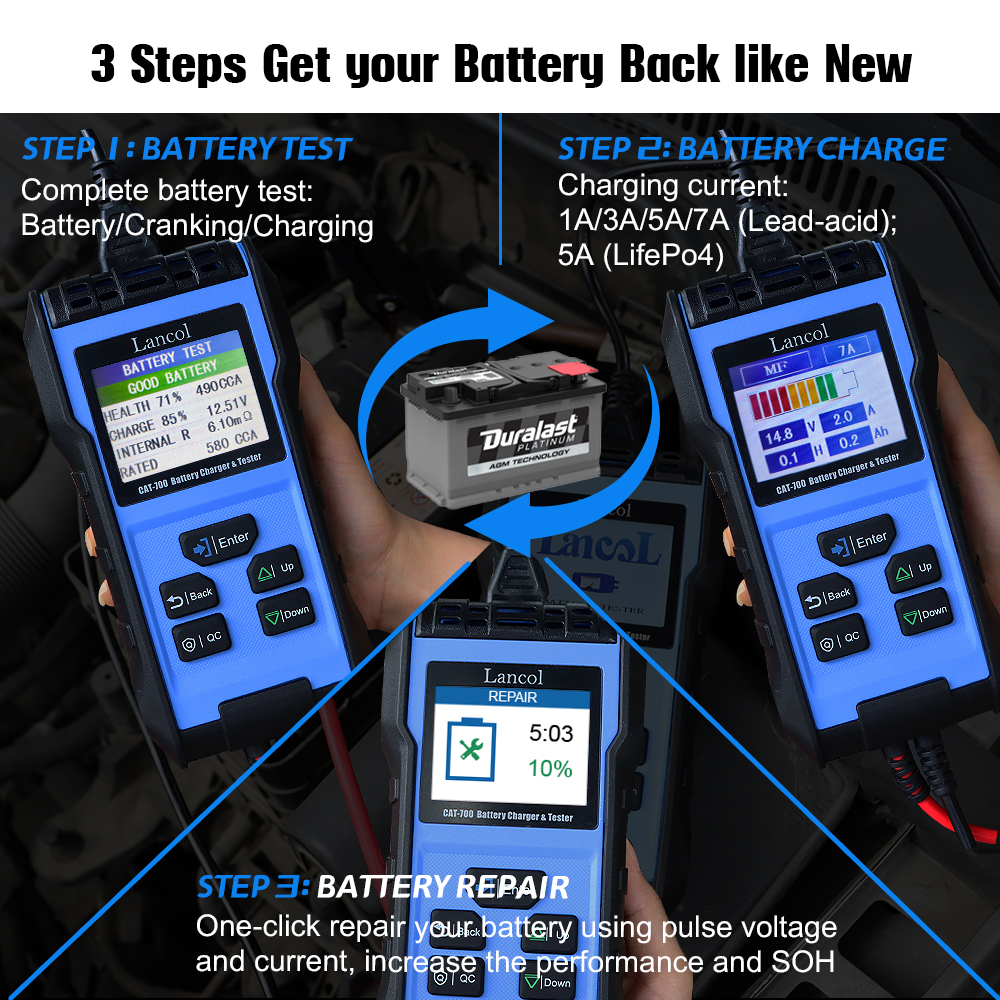
Modern battery chargers – like those from professional manufacturers such as Lancol – are not just “power supplies.” They are smart chargers that automatically detect battery type, voltage, and state of charge, then adjust the current accordingly. A quality charger may offer multiple current settings (e.g., 2A / 10A / 20A) and switch to a maintenance trickle charge when the battery is full. This is far safer and more effective than blindly using the highest current available.
So, what should you look for?
Instead of chasing the highest amperage, consider:
- Match the charger to your battery’s size and type. For a standard car battery (40–60Ah), a 6A–12A charger is usually ideal.
- Adjustability. A charger with selectable current levels gives you flexibility for different batteries.
- Safety features. Overcurrent protection, reverse polarity protection, temperature compensation, and automatic shutoff are must-haves.
- Trusted brand. Choose a reputable manufacturer like Lancol that provides clear specifications and reliable performance.
Final verdict
A larger charging current is not universally better. It’s like driving a car – flooring the accelerator might get you there fast, but it also burns fuel, wears out the engine, and risks a crash. The best battery charger is the one that delivers the right amount of current, safely and intelligently, for your specific battery.
So next time you’re buying a battery charger, don’t just ask “What’s the maximum current?” Instead, ask “What current is right for my battery?” Your battery will last longer – and you’ll avoid unnecessary damage and danger.